
Eureka!
At last I have found a way to describe the result of NAIRU-regulation of unemployment outside of the self defined.
It happened as I tried different ways to find some correlation between the real existing rate of unemployment and the changes in monetary economy[i].
Then i found an even better correlation between “Jämviktsarbetslöshet” – NAIRU – and the privately owned part of the Swedish national wealth. An x/y-diagram where x was the declared NAIRU unemployment rate from SCB, Statistics Sweden and KI, National Institute of Economic Research, NIER[ii] and y = the privately owned fortunes part of the national wealth in percent according to Daniel Waldenströms Swedish National Wealth Database[iii] (diagram shown below) has the y = 5,4519x + 0,3634, and the correlation coefficient R² = 0,8973. The p-value for the constant is 2,61E-11 so it would look as the variables really are correlated.
If the calculated NAIRU-level of unemployment is defined as one percent higher, the private part of the national wealth will at the same time be about five percent more.
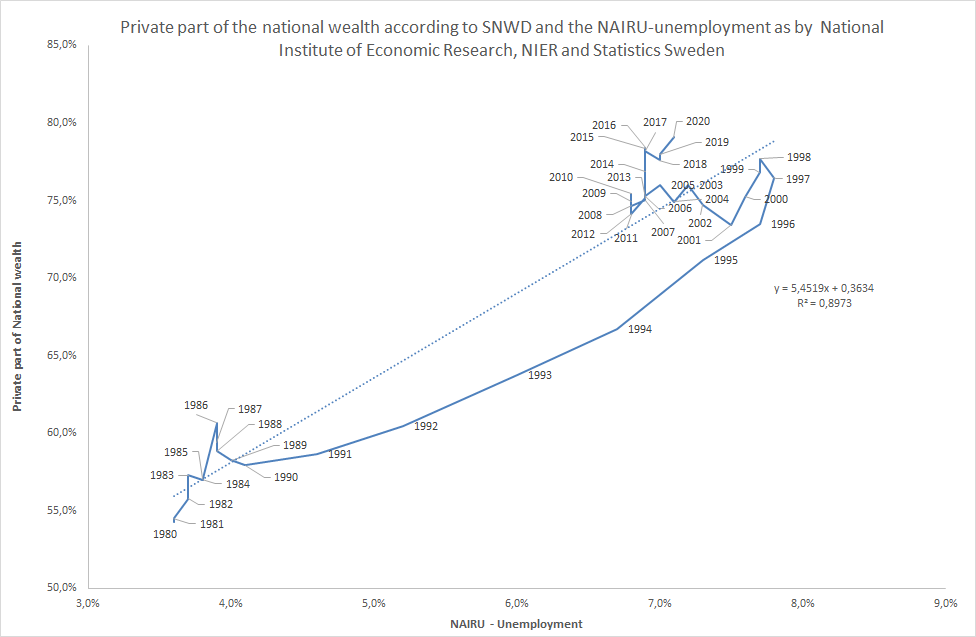
It would be quite interesting if somebody would check if the NAIRU-computing method used by SCB/KI could result in NAIRU-unemployment correlating to changes in the private part of the national wealth! And in that case why!
[i] in Swedish https://www.fredtorssander.se/fredpress/2026/04/21/tido-regeringens-arbetsloshetspolitik/
[ii] Jämviktsarbetslöshet https://prognos.konj.se/PxWeb/pxweb/sv/SenastePrognosen/SenastePrognosen__f24_resursutnyttjande/F2401.px/
[iii] https://sites.google.com/view/danielwaldenstrom/data-programs Inequality and taxation: Swedish National Wealth Database, 1810-2020 (xlsx) /actually appended to 2023/
